 VapeWholesaleHub
IVG Reload Cell and Chip Supply Constraints — Plain Language
Retailers rarely lose money on ivg reload because of price. They lose money because the first container was bought on a photograph. This page walks through what actually matters when you source ivg reload at scale, written from the buying desk rather than the marketing department.
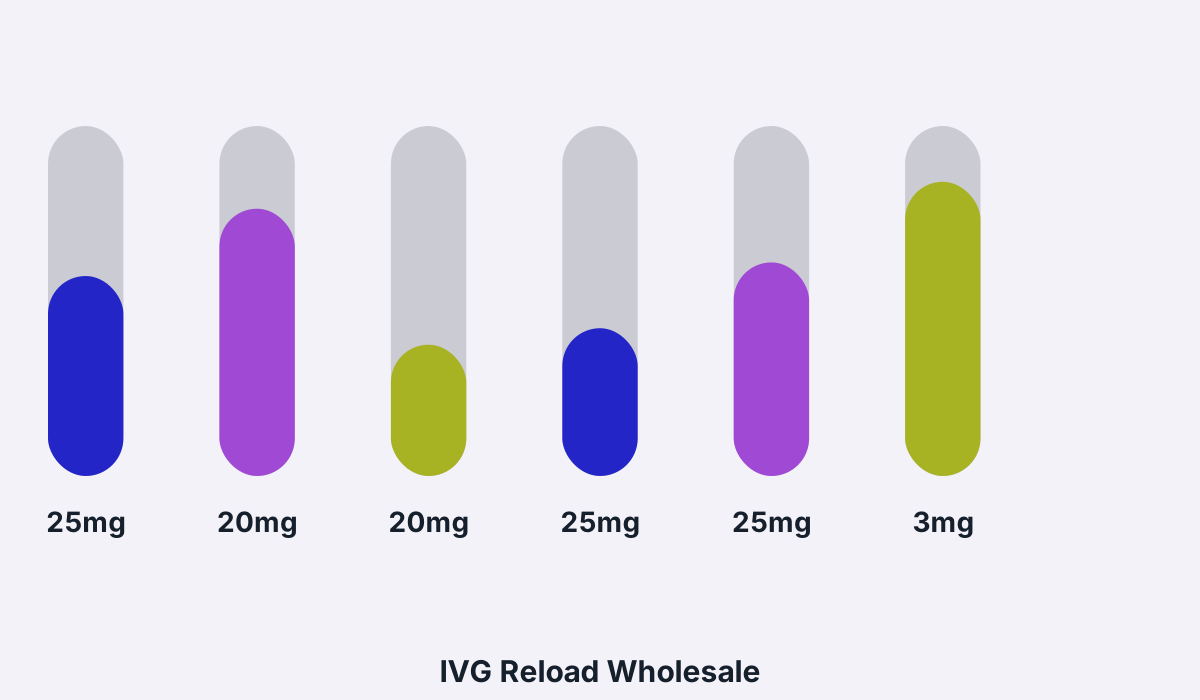
Modelling a Healthy Margin
Discounting ivg reload to win shelf space tends to reset customer expectations permanently. Volume support in kind, such as display material, usually costs less in the long run.
When ivg reload input costs move, ask which component moved. A generic price increase hides whether you are paying for cells, packaging or simply a busy production calendar.
Indicative reference points for planning purposes: entry tier from USD 2.27 per unit at 500 units, mid tier at USD 1.57, and volume tier at USD 1.38 for full container quantities. These figures move with specification, packaging and freight, so treat them as a shape rather than a quote.
Quality Control in Practice
The cheapest quality control step is a retained sample. Keeping three sealed units from every ivg reload batch costs almost nothing and turns any dispute into a simple comparison instead of an argument over photographs.
- Confirm the current customs classification with your own broker.
- Keep sealed retained samples from every production batch.
- Check carton dimensions against your freight quote before confirming.
- Rotate stock by batch code rather than by delivery date.
- Agree the tolerance band in writing before approving artwork.
Getting IVG Reload to Your Warehouse
Plan the ivg reload customs paperwork at the same time as the order, not when the goods are on the water. A missing document costs more in demurrage than the entire freight saving from a cheap forwarder.
The Specification That Matters
Good ivg reload specs describe the failure boundaries, not just the target. Stating what is unacceptable gives the factory a clear production window instead of a single point they will miss half the time.
Good ivg reload specs describe the failure boundaries, not just the target. Stating what is unacceptable gives the factory a clear production window instead of a single point they will miss half the time.
| Product category | Open system |
|---|---|
| Resistance band | 0.6 - 0.8 ohm |
| Capacity tolerance | +/- 5% |
| Puff count method | Machine cycle 2s on / 18s off |
| Master carton | 120 units |
| Carton weight | 8.9 kg |
| Shelf life | 18 months |
| Storage | 15-25 C, dry, away from direct light |
Where IVG Reload Sits in the Range
IVG Reload sits at an interesting point in the assortment. It is familiar enough to be an impulse purchase and specific enough to build a repeat pattern around. Treating it as either pure commodity or pure specialty both lead to poor results.
Decide early whether ivg reload is a traffic driver or a margin line in your store. The answer changes how you price it, where you place it and how hard you push it at the counter.
Where Demand Is Heading
Retailers report that ivg reload customers are asking more specific questions than they did two years ago. That favours ranges with clear, simple information over ranges with clever marketing.
Practical Checklist
- Check carton dimensions against your freight quote before confirming.
- Confirm the current customs classification with your own broker.
- Keep sealed retained samples from every production batch.
- Rotate stock by batch code rather than by delivery date.
- Agree the tolerance band in writing before approving artwork.
- Start with a mixed carton and let your own sell-through decide.
Frequently Asked Questions
How do you handle a short shipment?
Cartons are counted and weighed before dispatch and the figures are shared with you. If something is short on arrival, the packing record and the carrier documentation are both available, which keeps the claim straightforward.
Do you provide compliance documents?
Every shipment leaves with the documentation set relevant to your market, including batch records and test reports where required. Your local rules still determine what you must file, so confirm those with your broker before import.
What if I only need a small first order?
That is normal and sensible. A mixed carton lets you test ivg reload in your own market before committing to a production run, and the specification you approve at that stage carries through to larger orders unchanged.
Can I mix strengths in one order?
In most cases yes, as long as each strength meets the minimum run length. Mixed strength cartons are popular with retailers building their first display because they show the full ladder without over committing.
What information do you need to quote?
Target specification, approximate quantity, destination and any packaging requirement. With those four we can usually come back with a costed option the same working day rather than a request for more information.
Next Step
Whatever you decide, decide it against numbers you can check on arrival. That single discipline removes most of the risk from importing ivg reload.
Related Reading
- IVG Reload Last Mile Delivery for Local Retailers — New Distributors
- IVG Reload Safety Stock Levels for Import Programmes — Real Numbers Only
- IVG Reload Seasonal Peaks and Stock Cover — the Middle East
- IVG Reload Review Mining for Product Insight — Low Minimum Quantities
- IVG Reload Shelf Life, Batch Codes and Traceability — Mixed Cabinets
- IVG Reload Handling, Labeling and Regulatory Paperwork — Step by Step